LANGSTON MASINGALE INDUSTRIES × COSMIC AUDIO LAB
D’lux Suite
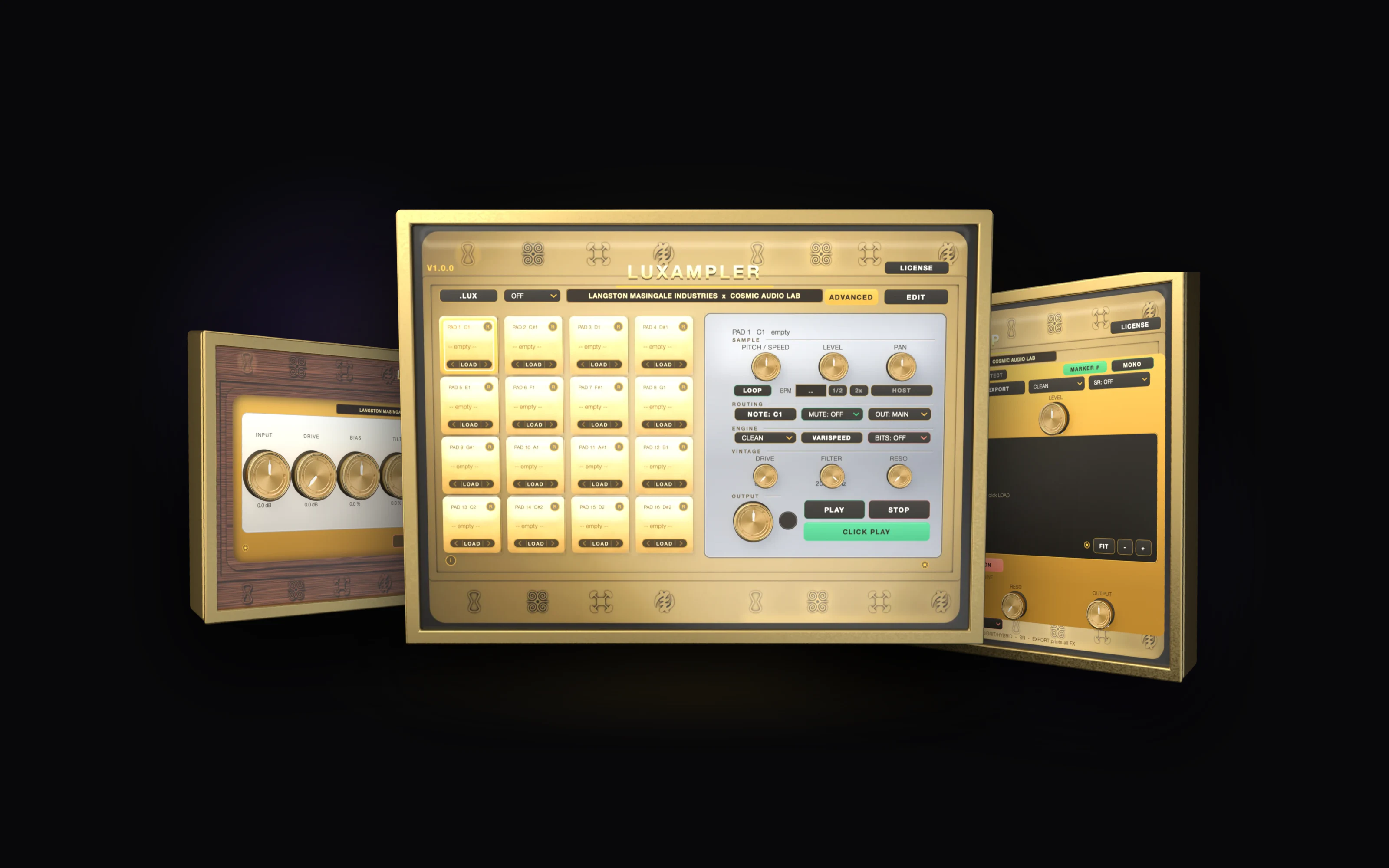
A sixteen pad sampler, a chop deck and a saturator, struck from the same gold.
Three plugins built the way hardware used to be built: one job each, no menus to dig through, and nothing on the audio thread that could ever make you miss a take.
Scroll to explore
16 PADS
PER PAD ADSR
CHOKE GROUPS
16 AUX OUTS
KEYLOCK & VARISPEED
BIT DEPTH
SAMPLE RATE REDUCTION
MIDI LEARN
.LUX KITS
ASYMMETRIC BIAS
TILT
PUNISH
EXPORT PRINTS FX
REAL TIME SAFE
THE SUITE
Three tools. One workflow.
Load it, chop it, dirty it. Each plugin does one thing completely, and the three of them share a face, a preset language and a signal path, so moving between them costs you nothing.
Luxampler
The kit sampler
Sixteen pads, a different sample on every one, and a full voice behind each pad instead of a shared one. Build a kit, save it as a .lux file, carry it to the next session.
Per pad voice. ADSR, drive, filter with resonance, bit depth, sample rate reduction, tune, pan and level. All per pad, not per instrument.
Three algorithms. Clean, Grit and Hybrid, switchable per pad, so one kit can hold a pristine 808 and a crushed break.
Choke groups and stacking. Pads that cut each other off, or two pads on one note to layer.
Sixteen aux outputs. Every pad can leave on its own channel for mixing.
Keylock or Varispeed. Follow the host tempo, or let pitch move with speed the way the old boxes did.
Luxamp
The chop deck
One sample, two markers and a controller. Ride the in and out points over MIDI CC while it plays, so you chop by hand instead of by grid.
Markers on a knob. Start and end are automatable parameters with learnable MIDI CC, so the chop moves under your hand without opening the window.
Loop, reverse, normalise. The three edits you actually reach for, done to the sample rather than bolted on after it.
Vintage engine. Word depth and sample rate reduction with drive, filter and resonance behind them. The noise floor comes with it.
Keylock or Varispeed. Keylock moves pitch and leaves the length where it was; Varispeed drags both together the way the old boxes did.
Export prints the effects. What lands on disk is what you were listening to, run through the same DSP rather than a clean copy of the source.
LuxGrit
The saturator
The Only Saturator and Distortion You Need. It puts weight on a drum bus, teeth on a sample, and hair on a vocal, and it gets out of the way when you turn it down.
Drive with Bias. Push the stage off centre for even order weight instead of the symmetrical fuzz everything else gives you.
Tilt before the stage. Decide what gets dirty first. Lean the spectrum into the drive rather than cleaning up the mess afterwards.
Crush. The digital end of the range, for when analogue warmth is not the assignment.
Punish. One button. You will know when you need it.
Clean at zero. Turn it down and the path is transparent, a true bypass rather than a quieter version of the effect.
HOW THEY ARE BUILT
Built like hardware, not like software.
The interesting decisions in a plugin are the ones you never see. These are ours.
Offline by default
Nothing here reports back. There is no analytics and no account to create before you can make a sound, and a licence verifies against a file already on your disk. The one request these plugins ever make is a version check, which you can dismiss for good.
Native everywhere
One universal binary for Apple Silicon and Intel. A native 64 bit build for Windows 10 and 11 with the runtime linked in, so there is no redistributable to chase before your session opens.
THE MAKERS
D’lux Suite is the work of two shops, and the × in the name is the point. This is a collaboration, not a licensing deal. Every control on these three plugins had to survive two questions: does it sound like something, and does it still behave at three in the morning with a full session open and a deadline in the way.
Sampling has never been about clean. It is about what a machine did to a sound on the way through, and whether you could get back there again tomorrow.
COMPATIBILITY
Where they run.
Formats
VST3
All hosts
Audio Unit
macOS
AAX
Pro Tools
Standalone
No host needed
Systems
macOS
10.15 Catalina and later
Architecture
Universal, Apple Silicon and Intel
Windows
10 and 11, 64 bit
Runtime
Linked in, nothing to install
Instrument
Pads
16 per instance, MIDI note or click
Outputs
Stereo main + 15 aux buses (Luxampler)
Audio files
WAV, AIFF, FLAC and MP3 at any rate
Presets
.lux kits, portable across platforms
Engineering
Audio thread
No allocation, no locks, no file access
Code signing
Developer ID, hardened runtime, notarised, stapled
Runtime network
None, beyond a version check you can dismiss
Activation
Offline, no dongle, free trial
Hosts
Logic Pro · Ableton Live · Pro Tools · Cubase · Nuendo · Studio One · Reaper · FL Studio · Bitwig · Digital Performer · Cakewalk
Any host that loads VST3, AU or AAX.
GET THE SUITE
Take all three.
The suite is the way in: one purchase, one install, and the three plugins that were built to be used together. Every one of them is also sold on its own, and every one of them has a free trial, so nothing here needs your card before you have heard it.
THE BUNDLE
D’lux Suite
Luxampler, Luxamp and LuxGrit together, in one checkout instead of three.
Luxampler The Ultimate Sampler
Luxamp One sample, two markers, chopped by hand
LuxGrit The Only Saturator and Distortion You Need
VST3, AU, AAX and Standalone. macOS 10.15+ Universal and Windows 10/11 64 bit. Offline activation, no dongle, no account.
OR ONE AT A TIME